


90-Day Marketing System: How to Build a Plan That Actually Compounds
Growing a business through marketing shouldn't feel like starting from scratch every month.
If you're a business owner juggling a dozen priorities, the real problem usually isn't effort — it's that marketing becomes a series of disconnected tasks: a few posts here, a campaign there, a website tweak when something breaks. It's busy, but it doesn't build momentum.
A 90-day marketing system fixes that. Not by adding complexity, but by creating a repeatable way to pick the right goal, focus on the right channels, produce the right assets, learn from data, and improve every cycle.
Before you dive in: If you'd rather start with a structured template, grab our free 2026 Growth Planner — a ready-to-use marketing blueprint with a clear 30-day execution map built in.
Below is the exact framework we use at Hyperpath Digital to help growing SMEs turn "random marketing" into a compounding growth system — one that gets smarter and more effective with every passing month.
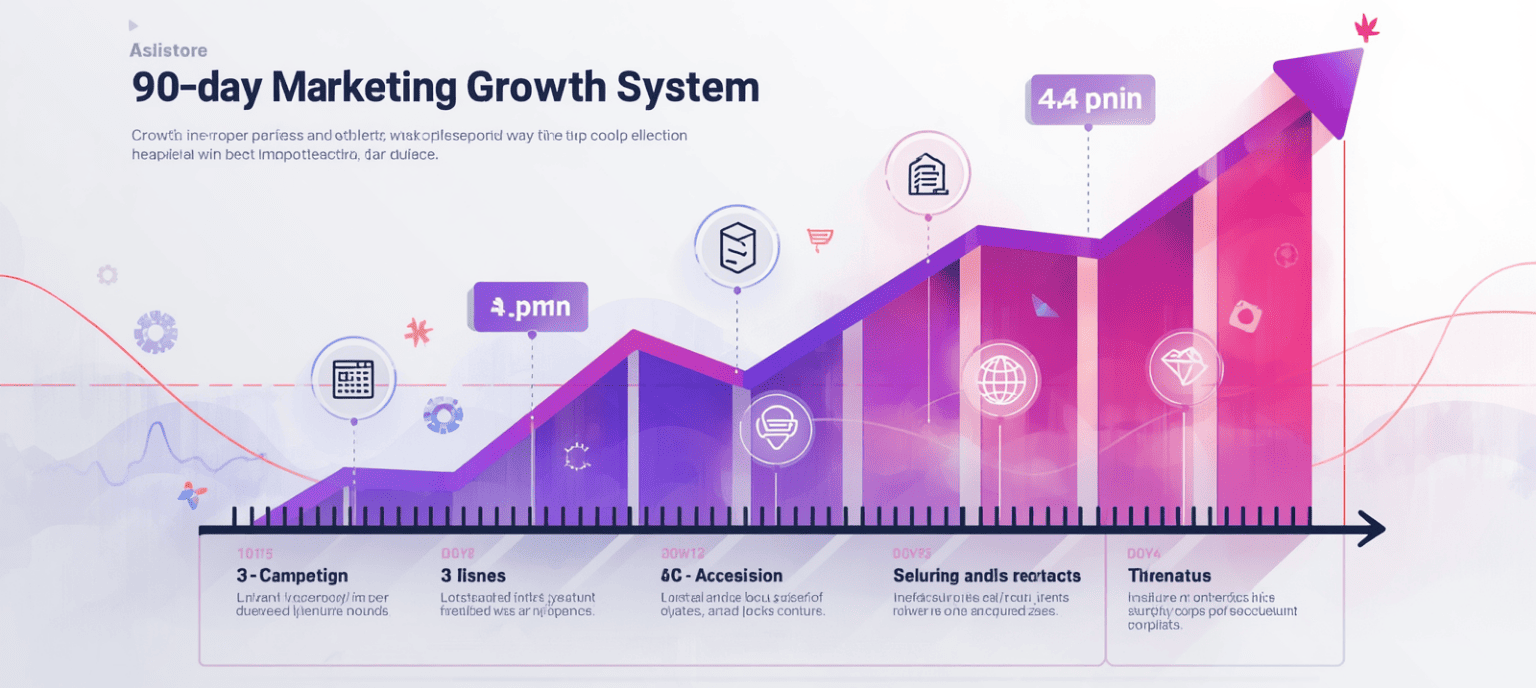
What a "Compounding" 90-Day Marketing System Actually Means
Compounding marketing means the work you do this month makes next month easier — and more effective.
Here's what that looks like in practice:
- A strong landing page improves every campaign that points to it.
- A clear positioning message makes ads, emails, and sales calls convert better.
- A content pillar becomes 10+ smaller assets you can distribute for weeks.
- A consistent reporting loop prevents you from repeating the same mistakes.
Non-compounding marketing is the opposite: everything is one-off, results are hard to explain, and you're always guessing what to do next.
A 90-day system is the sweet spot — long enough to build real traction, short enough to stay honest and adapt when something isn't working.
Step 1 — Set One Clear Business Objective (And the Few Metrics That Matter)
Most marketing plans fail before they start because the "goal" is actually a list:
- "More leads"
- "More brand awareness"
- "Improve social"
- "Launch a new offer"
In a 90-day system, you choose one primary business objective. Everything else supports it.
The Objective → Strategy → Metrics Chain (Simple, But Strict)
Use this chain to force clarity before you spend a single hour or pound on execution:
Objective (business outcome): What must be true in 90 days? Strategy (how you'll get there): The main approach in one sentence. Metrics (proof): The smallest set of numbers that confirm real progress.
Example (anonymised client scenario):
- Objective: Generate 35 qualified consultation requests in 90 days
- Strategy: Improve lead quality by tightening targeting, rebuilding the landing page, and adding a nurture sequence
- Metrics: Consultation requests (primary), Landing page conversion rate, Cost per qualified lead, Lead-to-meeting rate (quality check)
Template — copy and use this:
- Objective (90 days): ____________________________
- Strategy (one sentence): ____________________________
- Primary KPI: ____________________________
- Supporting KPIs (max 3): ____________________________
- Guardrail metric: ____________________________
Not sure what to pick? Choose the metric closest to revenue that you can actually influence within 90 days. Our digital strategy and performance marketing service starts exactly here — defining the objective before anything else moves.
Step 2 — Map the Customer Journey (So Your Work Connects End-to-End)
A compounding system is full-funnel by design — even if you're only actively working on one stage at a time.
Why? Because every channel you use is part of a journey. If you don't map it, you'll optimise the wrong thing and wonder why results plateau.
A Practical Journey Map You Can Build in 30 Minutes
Draw a simple five-stage journey and answer the questions under each one:
| Stage | Key Question |
|---|---|
| Trigger | What causes someone to start looking for a solution? |
| Discovery | Where do they first hear about you? |
| Evaluation | What do they compare, question, or need proof on? |
| Decision | What makes them convert — or walk away? |
| Success | What makes them stay, expand, and refer others? |
For each stage, ask:
- What questions are prospects asking?
- What assets do we already have here (if any)?
- Where are we currently losing people?
This 30-minute exercise will surface more useful strategic insight than most full-day planning sessions.
If you need support structuring this from scratch, our full-funnel performance marketing approach covers journey mapping as part of every growth strategy we build.
Step 3 — Choose Channels That Match Your Stage (And Stop Over-Spreading)
One of the most common patterns among growing SMEs: trying to do everything at once.
SEO + Google Ads + Meta Ads + LinkedIn + email + webinars + partnerships… That's not a digital growth strategy — that's spreading risk because there's no system behind the activity.
Channel selection should be based on four honest criteria:
- Your timeline (90 days is not forever)
- Your budget and team capacity
- Where your buyers actually pay attention
- What you can measure and genuinely improve
The 70/20/10 Channel Allocation Rule
To keep focus without becoming fragile:
- 70% — Core channels: 1–2 channels you commit to executing every single week
- 20% — Support channels: Channels that amplify the core (usually email + retargeting)
- 10% — Experiments: One new angle you can test without derailing everything else
Example allocations:
B2B service business (lead generation focus):
- 70%: Google Search Ads + landing page optimisation
- 20%: Email nurture + LinkedIn distribution
- 10%: One webinar or partner co-marketing test
Ecommerce (profitability focus):
- 70%: Meta prospecting + product page optimisation
- 20%: Email/SMS flows + retargeting
- 10%: Creator whitelisting test
The goal is fewer moving parts, faster learning, and a performance marketing system that compounds — rather than spreading effort so thin that nothing gets proper attention.
For businesses unsure where to start, our SEO and conversion optimisation service is often the highest-ROI core channel for SMEs with a 90-day horizon and an established website.
Step 4 — Build a Content System (Not a Content Calendar)
A calendar tells you what to post. A system tells you how you'll produce, reuse, and distribute assets so output doesn't collapse the moment you get busy.
The "Pillar → Spinoffs → Distribution" Engine
- Pillar: One high-value asset (guide, case study, comparison, webinar, landing page)
- Spinoffs: 6–12 smaller pieces derived from the pillar
- Distribution: A clear plan for getting those pieces in front of the right people, across both organic and paid channels
This is how content starts compounding — every pillar becomes a library you draw from for weeks.
Example 90-Day Content Cadence (B2B Service Business)
Monthly pillar (×3):
- Month 1: "How to choose [service] without wasting budget" (guide)
- Month 2: "What it actually costs to do [service] properly" (breakdown)
- Month 3: "Common mistakes + how to fix them" (diagnostic)
Weekly spinoffs (2–3 per week):
- 1 short LinkedIn post (lesson drawn from the pillar)
- 1 carousel or visual framework
- 1 email (single idea + one clear CTA)
Always-on conversion asset: One landing page aligned to your 90-day objective — with a clear offer and proof that it works.
Building this kind of content engine is exactly what our social media and content marketing service is designed to support — from pillar creation through to weekly distribution, without the guesswork.
Step 5 — Create Weekly Execution Rhythms (So It Actually Happens)
Most plans fail not because the strategy was wrong, but because they were built like a document — not a workflow.
Your 90-day system needs a weekly rhythm that fits real life, not an ideal version of it.
The Monday Plan / Thursday Build / Friday Review Loop
Monday (30–45 min) — Plan:
- Confirm this week's single priority
- Assign owners and deadlines
- Quick scan of last week's numbers
Thursday (60–120 min) — Build:
- Produce the week's asset(s)
- QA landing pages, tracking, and links
- Schedule distribution
Friday (30 min) — Review:
- What moved?
- What didn't?
- What's the one change we make next week?
This rhythm creates consistency without requiring daily standups or endless check-ins. Three focused sessions. That's it.
Step 6 — Install Feedback Loops That Improve Results Every Month
Compounding doesn't come from "more content" or "more ad spend." It comes from learning loops — structured cycles that make every month smarter than the last.
A feedback loop is simply: measure → interpret → decide → implement → repeat.
What to Track Weekly vs Monthly
Weekly (fast signals):
- Spend and pacing (if running ads)
- Leads and sales volume
- Conversion rates on key steps (landing page, form, checkout)
- Top-performing creative or content
Monthly (decision signals):
- Channel ROI and efficiency trends
- Lead quality indicators (meetings held, early close-rate signals)
- Customer acquisition cost trend (where available)
- Retention and repurchase signals (if applicable)
Keep reporting simple: one page, a few clear charts, honest notes. The goal is decisions, not a dashboard that nobody reads.
For teams that want to reduce the manual work in this loop, our AI-powered automations service can connect your reporting, alerts, and workflow triggers — so you're acting on data faster without spending hours compiling it.
Templates You Can Copy (90-Day Plan, Weekly Sprint, Reporting)
Use these as starting points and adapt to your business. Or, if you'd prefer a pre-built version that's ready to fill in, download our free 30-day execution roadmap — it covers goal setting, funnel structure, channel selection, and weekly actions in one clean document.
1) 90-Day Plan (one page)
- Objective:
- Strategy:
- Core channels (70%):
- Support channels (20%):
- Experiments (10%):
- Key assets we must build:
- Weekly rhythm:
- KPIs + targets:
2) Weekly Sprint Board
- This week's priority:
- Tasks (max 5):
- Owner:
- Due date:
- Blockers:
3) Monthly Review Notes
- What worked (and why):
- What didn't (and why):
- What we'll do next month:
- What we're stopping:
The Differentiator: Why Most 90-Day Plans Fail (And How to Avoid It)
Most 90-day marketing plans look good in a slide deck — but fall apart in execution for one core reason:
They're built around activities, not a system that connects strategy, production, distribution, and measurement into something that actually holds together under pressure.
At Hyperpath Digital, we treat a 90-day plan like an operating system:
- Strategy is tied to a measurable objective — not vague "awareness" goals.
- Channels are chosen based on real capacity and buyer behaviour — not whatever's trending.
- Content is built as an engine (pillar → spinoffs → distribution), so it scales without burning out your team.
- Reporting is designed for decisions, not vanity metrics.
- The cadence is realistic — so it survives busy weeks, not just quiet ones.
That's the difference between "we tried marketing for a bit" and "marketing is now a predictable part of how we grow."
Ready to Build Your 90-Day System — With Support That Keeps It Running?
If you'd like, Hyperpath Digital can help you build a 90-day marketing system tailored to your goals — then support the execution and optimisation so it actually compounds over time.
As a performance marketing and digital growth agency working with SMEs, we've seen first-hand what separates plans that work from plans that sit in a Google Doc and gather dust.
Two ways to get started:
- Explore our performance marketing and growth strategy service — and see what a focused, structured 90-day sprint looks like when it's built and run with you.
- Grab the free Growth Planner — a no-cost starting point with goal definition, funnel structure, channel selection, and a 30-day execution roadmap your team can follow immediately.
Either way, the next 90 days can look very different from the last 90. The system is here — you just need to start.